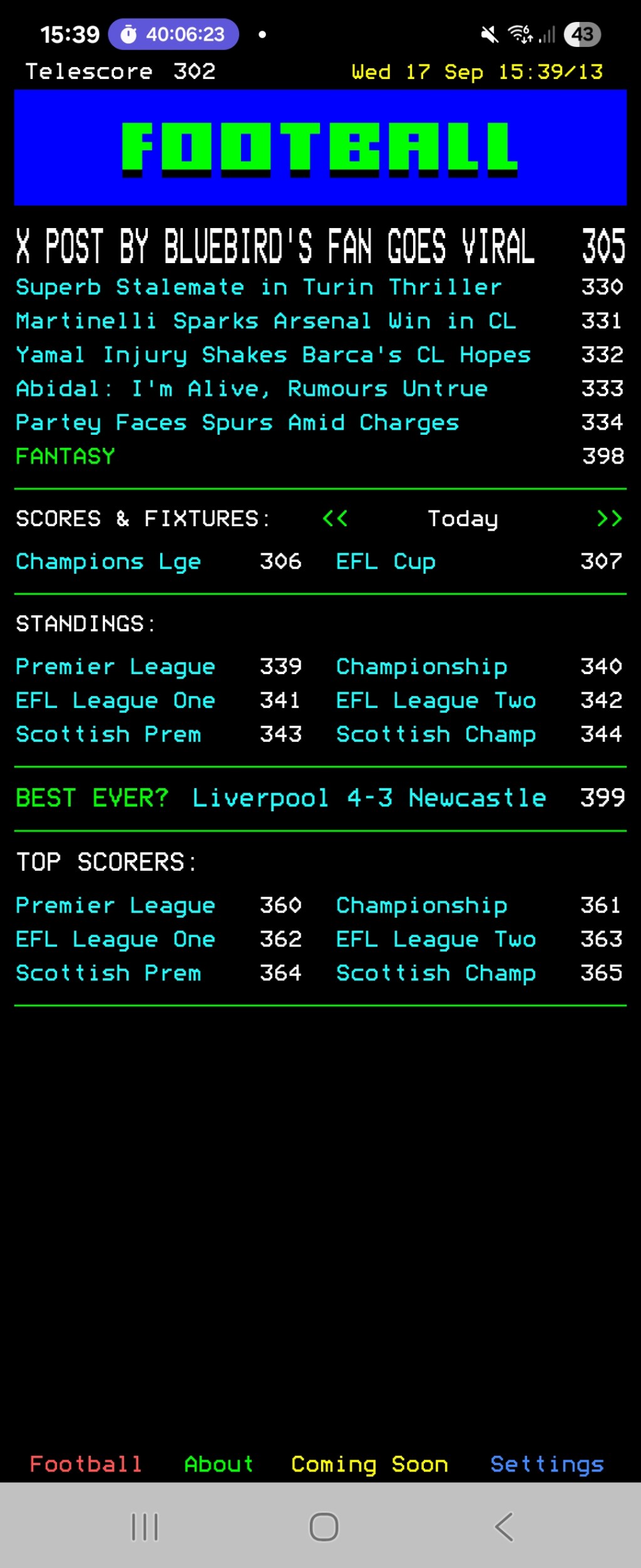
The joy of checking football scores via teletext is something of a lost art.
But a new app built by Mike Reynolds is scratching the itch for those who want to experience accessing live scores and football news through the distinctive colourful text and rudimentary graphics once synonymous with services like BBC Ceefax.
Core memories unlocked
Opening the app ‘Telescore’ will instantly unlock core memories for football fans above a certain age, and unleash a warm fuzzy feeling from a more straightforward time, that any social media feed, live score app or YouTube ‘watchalong’ just cannot recreate.
The app currently offers scores – including from English and Scottish leagues – news, and top goalscorer lists.
“I wanted to build a football stats app. That’s how it all started,” Reynolds, app owner and developer, told Interrobang News,
“I was getting tired of the missus asking me who to put in her bet builder! I figured one of the features needed to be live scores – so I decided to start there.
“I got the live scores working – and started thinking about how I wanted it to look. It hit me that it should look like Ceefax – I think I was walking the dogs at the time! Quickly, I realised I might be onto something people wanted so I ditched the stats idea and purely focussed on the live scores and making it look how it does.”
Social media buzz
Reynolds’ new app has caused a real buzz on social media. And while the app had quietly launched back in May before Charlton Athletic’s League One play-off final with Leyton Orient, and grew a little more during the Women’s Euro 2025 championship, it’s really found its feet in recent weeks. Bands FC recently shared the app to its 54,000 X followers – while a headline on Telescore’s news section focuses on a Cardiff City fan posting the nostalgic buzz to X, getting thousands of likes, and boosting its app store ranking.
But the West Ham United fan’s own teletext memories mean these nostalgic vibes come as no surprise.
He added: “I’ve so many memories of teletext – mainly being at my nans house on a Saturday with my brother, uncle and cousins. We’d see the screen ‘flick’ and pray that when the next page appeared, West Ham had got a last minute winner – we were often disappointed.”
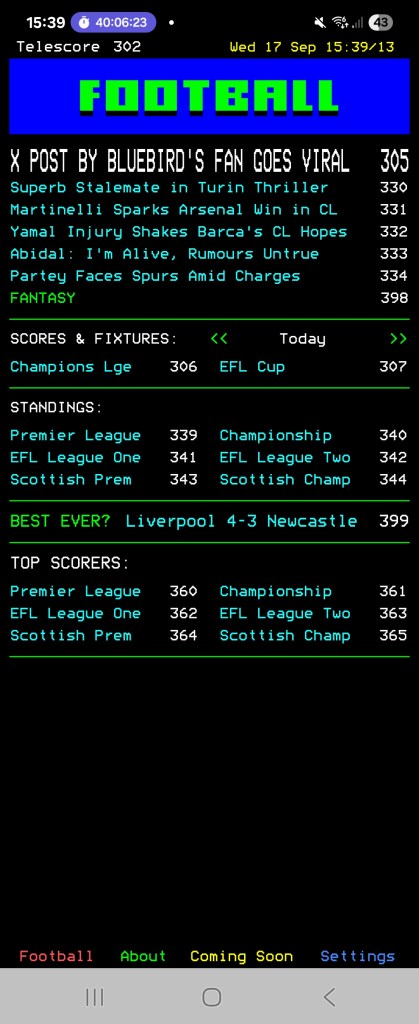
Teletext – a staple of British culture
Teletext had such longevity in British culture, that it should come as no shock that the app had racked up 4,500 downloads by the end of last weekend (14 September) – and, amid a surge of interest, is on course to surpass 10,000 by the end of the week.
He added: “The great feedback has been humbling, to say the least. I couldn’t have asked for a better response – and that is putting it lightly.”
Teletext first landed in the UK in the 1970s – and, given the rapid growth of the internet, had a remarkably good run, still being commonplace well into the new Millennium.
BBC Ceefax ran from 1974 until analogue TV’s demise in 2012, some 12 years after Sky Sports News (then SkySports.com TV) launched with its wall-to-wall sports coverage. The page numbers are etched into the brains of many fans – 300 for sport, 302 for football, 340 for cricket, and so on.
Pages from Ceefax even featured on regular TV during downtime – and, amazingly, were still running on BBC Two just two days before the Ceefax switch off in 2012.
But it wasn’t just the BBC who offered services like news, weather and sport via a text function – Teletext Ltd provided services to ITV, Channel 4 and Channel Five – but the plug was pulled in 2010. Elsewhere, and beyond football, Sky’s WWF text pages were legendary; and a must read in the late 1990s – famously sensationalist and packed full of rumours.
Other teletext services included holiday bookings, share prices, quizzes and even games.
Digital era – the long road to goodbye?
In the digital era, similar services have endured, and come and gone. In 1999, the BBC launched a digital text service, known first as BBC Text, then BBCi, before becoming BBC Red Button. For years, this retained many of the same page numbers and bookmarks as its analogue predecessor – and the Beeb even U-turned at the eleventh hour on switching off the service in 2020, amid protests. At the time, the BBC said it had found a way to “keep the most valued text and data elements of the red button service”.
Five years on, and while BBC Red Button text services haven’t officially gone away – their availability on television sets seems to have massively declined. On a Sky box, pressing the red button opens up an iPlayer box instead – and it isn’t obvious whether text based news, sport and other information is still available to us in any meaningful form. There’s some anecdotal claims on forums that it is only available on television sets not connected to the internet.
Meanwhile, a digital version of Sky Text ran from 2002 until 2013 – and while we’re sure at Interrobang HQ that some sort of app or services with league tables and fixtures endured on Sky Sports well beyond that, there’s very patchy information online. In a nutshell, like their analogue predecessors, digital teletext-style services seem to have largely had their day.
One man band
Historic news reports about teletext refer to 70 redundancies at Teletext Ltd, and dedicated staff in editorial suites. But Telescore app is a one man band, though Reynolds admits he gets some writing support from a much more modern phenomenon.
“Many people are surprised that Telescore is just me – an ordinary bloke, who loves football and happens to be able to code.
“Without giving too much away, the scores and scorers are automated, so it’s just a case of keeping an eye on things – unlike what teletext used to be like.
“But the news bit is different – that is a mostly manual process, which can be quite time consuming. I’m not a journalist, and do enlist AI to help with articles.”
The iconic look of Ceefax – with its distinctive blue banner, turquoise text and four colour menu palette has already proven the inspiration for other products – with companies like Retro Classic and RetroAway flogging t-shirts, and other merch, brandishing famous scorelines immortalised in the distinctive style. Clearly this BBC look is also the inspiration for Telescore, and there could be more features to come – potentially combining people’s nostalgia with the new statistical demands of football fans (although, we hope, not the somewhat tedious xG!).
Reynolds adds: “I think the football element still needs some improvement and new features. In the teletext era, nobody cared about assists – but Fantasy Football has changed that a bit, so it’s something I want to incorporate.
“Lots of people have asked for a Vidiprinter too, so that is in the works.
“I would love to expand into other sports too, but there’s no timelines for that right now. I think horse racing or cricket would be the first sports I look at – if and when time allows.”
Retro revival
Telescore isn’t the only option for fans wanting to digest their sports updates in a more minimalist, or at least traditionalist, fashion.
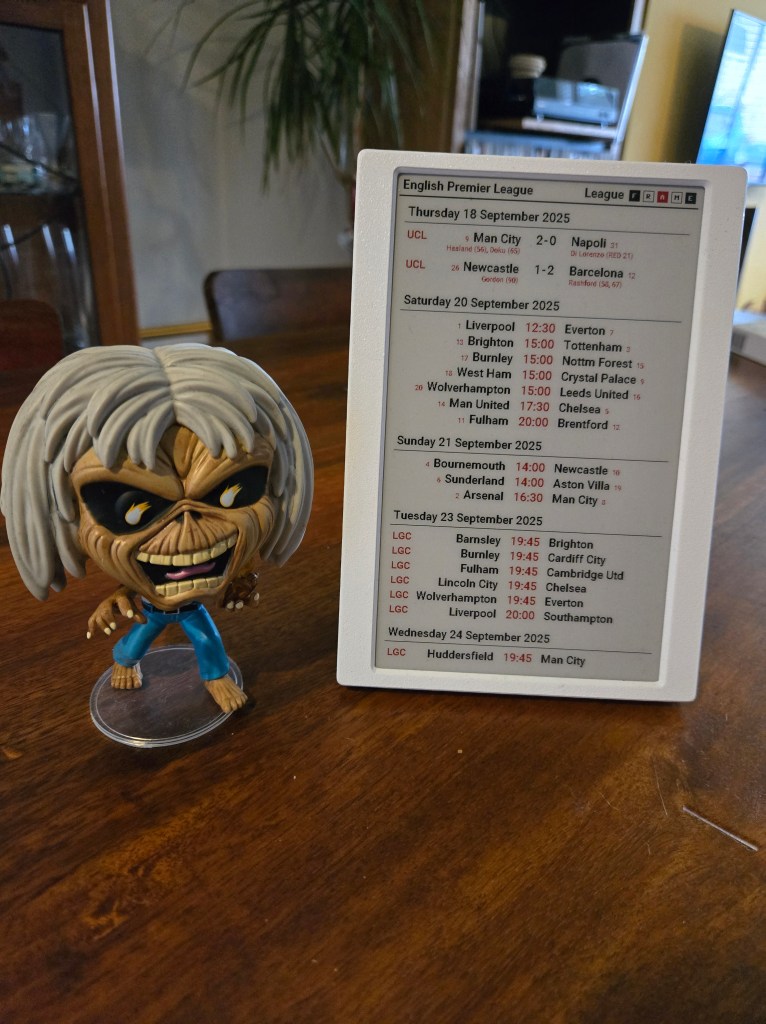
League Frame is a staple on the Interrobang HQ desk – a small 7.5″ Kindle- reader style screen that offers league tables, live scores and fixtures on a loop, in a fashion that definitely shares some similarities with teletext. The product advertises itself as offering “no tapping, no scrolling, no apps, no ads.”
And a little further afield, the Baltimore Ravens recently wound the clock back to 1996, with a temporary remodelling of their app to celebrate three decades of the NFL franchise – in the style of a 1996 website. Quite cool.
But for anyone who misses the rituals of checking news, facts and stats via teletext – Telescore is a must add to any smart phone. Telescore is available to download for free on app stores.
 Interrobang News
Leave a comment